Word studies are a common exercise in biblical studies and can yield valuable insights on the text. This page will walk you through the process of doing a word study in 3 steps.
Keep in mind that there a several different ways to do a word study, utilizing different tools. This page outlines a process that can be done entirely online, without additional resources. No matter what tools you may use, the basic principles are the same.
INTRODUCTION
Semantics
- Semantics is the study of meaning in language. The field of semantics has made tremendous impact on biblical studies. The most crucial thing to remember is that words get their meaning from the sentence in which they occur (not their etymology, or origin—sometimes called the “root fallacy”).
- Words can have varieties of meaning (sometimes called “semantic range” or “polysemy”), but it is the context of usage that shapes its specific meaning. A common mistake in word studies is to assume that the meaning of a word in one text also applies in another text (called “illegitimate totality transfer“). Try instead to discern the specific meaning of your chosen word in the text you are studying.
- Example of semantic range: a “pitcher” might refer to a baseball player, or perhaps a container for holding liquids (like a pitcher of water). The meaning of the word is determined by the sentence in which it occurs. “He threw the ball to the pitcher.” or “I’m thirsty! Could you pass the pitcher?”
Choosing a Word/Concept
- Begin with the passage you are studying and select a significant word that occurs there. If you are having trouble deciding which word to study, here is some helpful advice adapted from Gordon Fee’s New Testament Exegesis (2002; pp. 80-81).
- Note any words that are known to be “theologically loaded” (e.g. חֶסֶד (hesed “lovingkindness”), ἐλπίς (elpis “hope”), δικαιοσύνη (dikaiosunē “righteousness”), etc.).
- Note ambiguous words that make a significant difference in meaning.
- Note any repeated words in a section or paragraph that form a motif.
- Words to avoid:
- Conjunctions: and, but, also, etc.
- Pronouns: she, he, it, etc.
- Prepositions: in, with, by, on, etc.
- Articles: the, a, an
1: DISCOVER THE HEBREW / GREEK
This guide assumes you are working from an English translation, but it is important to remember that the Old Testament was originally written in Hebrew (plus a few small sections in Aramaic), and the New Testament was originally written in Greek. Once you have selected a word to examine from your passage, find the original Hebrew or Greek word using STEP Bible  . For illustration, I will do a word study on the word “city” in Isaiah 1:21.
>>> I recommend using the NASB2020 as your base translation.
>>> Hover over your word to bring up some basic information (or tap it once on a mobile device).
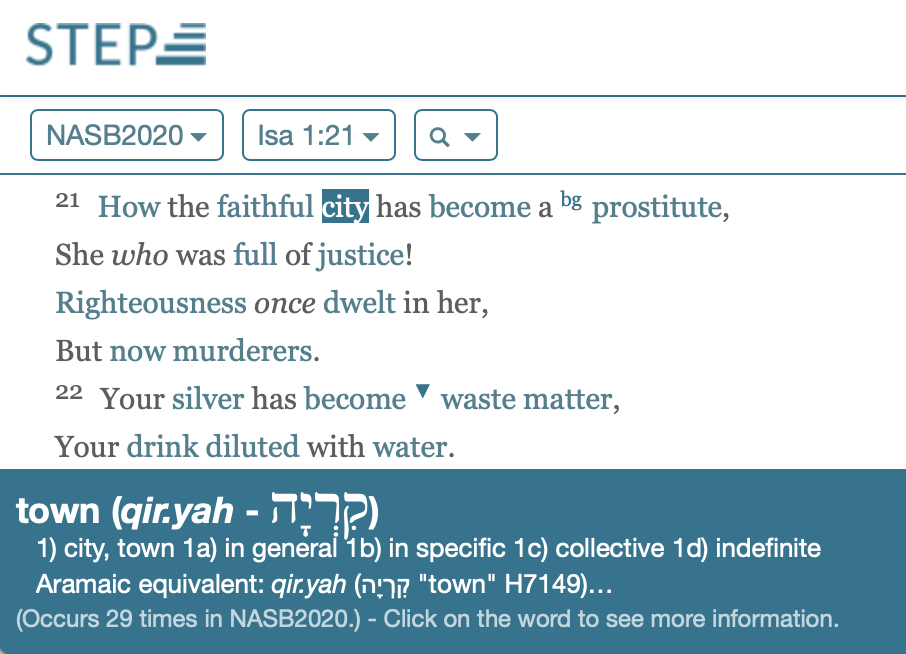
>>> Click on the word to bring up the “Word analysis.“
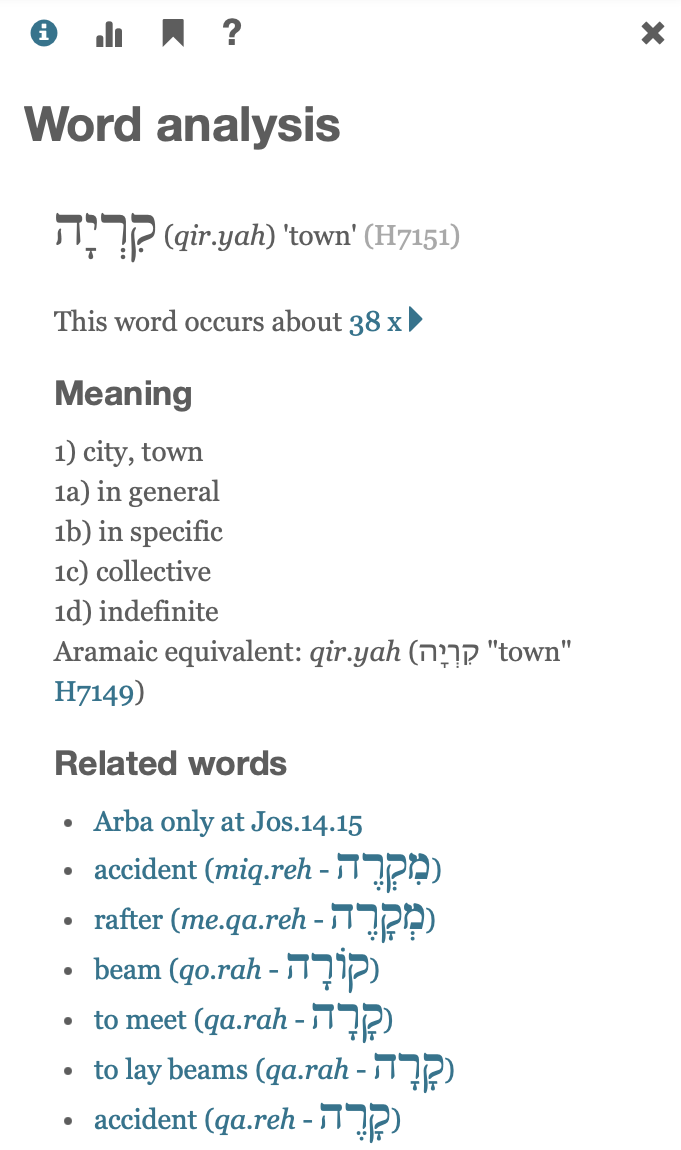
We now know the Hebrew word used in Isaiah. That word is the focus of our study.
>>> If you do not know Hebrew (or Greek), you can refer to your word by its transliteration.
- Important: STEP Bible inserts a period in the transliteration to help know where to divide between syllables. You should remove this period. For example, our word appears on the website as qir.yah. It should be changed to read qiryah (no period).
>>> Examine some of the other information in the word analysis box. It may be helpful.
- In our example, we do not learn much from the meanings that are listed. In general, don’t expect to find radically new information here. The vast majority of the time what you will discover is that the English translations have done a good job. The goal of a word study is not to “correct” the English translation (or find some “hidden” meaning).
- The most helpful information provided in this box is the range of meaning for your word.
2a: LOOK UP OTHER OCCURRENCES
The second, and most important, step of a word study is finding other places where our word is used.
>>> Click on the number just below your Hebrew word (in the example below, click on “38 x”).
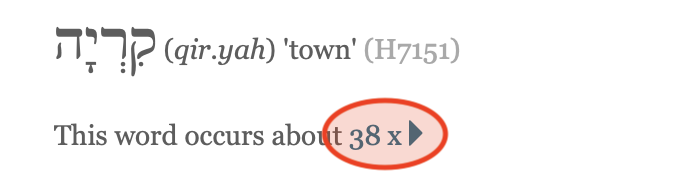
- This now changes the main window to a list of every verse where your Hebrew word occurs. Remember, this is not a list of every place where the word “city” occurs; it is a list of every place where the word qiryah occurs.
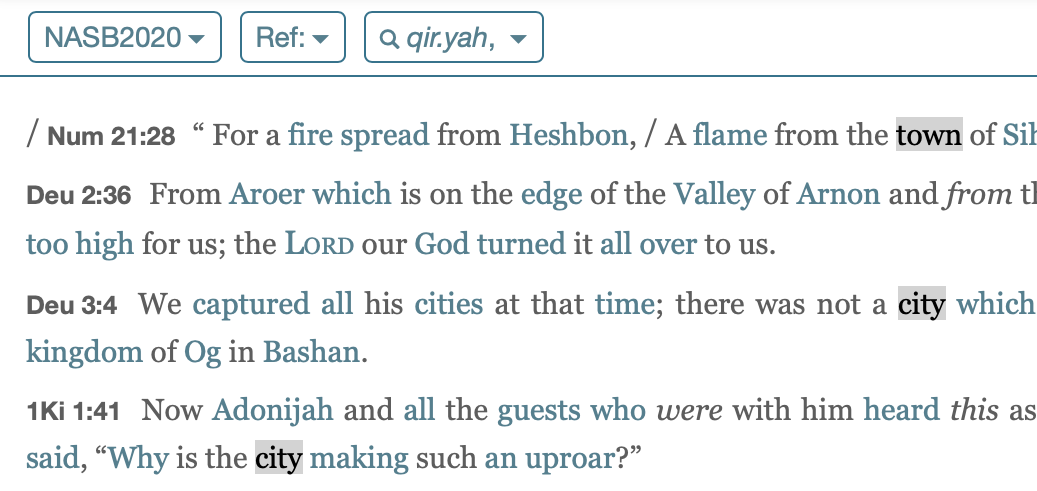
- You are now ready to begin your analysis of your list of texts.
>>> Start with all the places where your word occurs in the biblical book of your main text.
- Since we are analyzing the word qiryah in Isaiah 1:21, I want to first look at how the rest of Isaiah uses the term
- It is important to read the surrounding text of each verse.
Observations
- I notice that the word qiryah occurs in 10 verses in Isaiah.
- I also notice that all of these verses are in the section of the book known as First Isaiah (chs. 1-39).
- Many of the verses suggest a possible metaphoric use of the word qiryah (“city”):
- “faithful city” (x2)
- “jubilant city” (x2)
- “city of chaos”
- “cities of ruthless nations”
- “the unassailable city”
- Both verses which use “faithful city” occur close together in chapter 1. I discover that they are even part of the same passage.
- This short passage begins and ends with “faithful city,” suggesting that they form an inclusio.
- The central motif, or theme, of this passage (Isaiah 1:21-26) is the “faithful city.”
- Continue making more observations from your list of verses. Compare and contrast (consider what is similar and what is different) verses with each other.
- You may want to expand your analysis to every place where your word is used in all of the prophetic books. Or, you could examine every single usage in the entire Old Testament. Some words are used only a couple times, while others may occur thousands of times.
2b: LOOK UP SIMILAR WORDS
It is perhaps better to think of “word studies” as “concept studies.” Sometimes a passage will contain the basic concept of your word, but not use the same word. For example, it might use a synonym (much like how in English we might refer to a city, town, or village while all referring to the same basic context. Remember, the primary goal of our research is to better understand the meaning of the biblical text.
So that we do not miss out on important biblical data, it can be helpful to look up synonyms of your word.
>>> Search the English word “city” in the Bible.
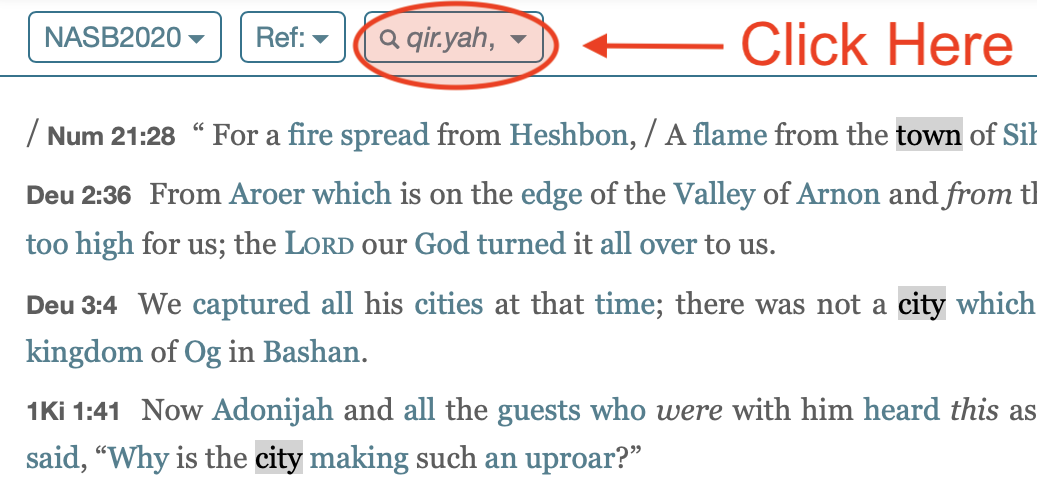
- You should now have a list of verses that use the English word city.
>>> Begin hovering over the word “city” in your list of verses (or tap if using mobile).
>>> Look for verses that have a different Hebrew word than qiryah.
- I discover that the word עִיר ir is often used for the basic concept of “city” in the Old Testament.
>>> Repeat the same steps as above (2a) to explore how that term is used.
- Consider using similar criteria to narrow your search. For example, you might examine every place where the word ir “city” is used in Isaiah.
- Repeat this process as necessary in order to understand your concept.
3: CONSULT OTHER SOURCES
The final step of doing a word study is to consult other sources that might discuss your term. It is important that you do not skip ahead to consult other sources until you have examined the biblical data for yourself. There is no substitute for direct study of your primary source.
There are an abundance of resources that might be useful in your word study. These might include theological dictionaries, commentaries, journal articles, or other scholarly books.
Unless you have access to an academic library, you may be limited in the types of sources you can examine.
Consider examining the following types of sources. Note that each link brings you to a page that provides a list of sources, along with links to some that may be available for free online.
- Commentaries
- Look in the introduction of your commentary. If your word is a major theme in your book, there may be a separate discussion of your concept here.
- Look at the discussion of every passage where your term is used in the book.
- Lexica / Dictionaries
- Look up your word in a lexicon or dictionary. Some dictionaries may arrange their entries in English (so you could just look up the word “city”). Others may list the word in Hebrew (or Greek/Aramaic). If that is the case, the Strong’s Number (found on STEP Bible) or perhaps an index in the back of the book may help you to locate the appropriate article.
- Journal Articles
- Monographs
- It is possible that your concept has been the subject analyzed in a full monograph (book-length study). These can often be discovered through a database like Index Theologicus.
- You may also discover academic dissertations on your concept in a database such as EThOS.
[Updated January 2024]
 Justin J. Evans